

'%3e%3crect opacity='0.2' width='32' height='32' fill='%2312306C'/%3e%3cpath d='M24.2885 25.0767C24.8494 24.964 25.1815 24.3707 24.8951 23.8718C24.2439 22.7376 23.2141 21.7409 21.8952 20.9822C20.2039 20.0094 18.1317 19.4821 16 19.4821C13.8683 19.4821 11.7961 20.0094 10.1049 20.9822C8.78587 21.7409 7.75609 22.7376 7.10495 23.8718C6.8185 24.3707 7.15063 24.964 7.71154 25.0767L8.68725 25.2727C13.5149 26.2424 18.4851 26.2424 23.3128 25.2727L24.2885 25.0767Z' fill='%2312306C'/%3e%3cpath d='M22.2359 12.2225C22.2359 15.659 19.444 18.4449 16 18.4449C12.556 18.4449 9.76407 15.659 9.76407 12.2225C9.76407 8.78589 12.556 6 16 6C19.444 6 22.2359 8.78589 22.2359 12.2225Z' fill='%2312306C'/%3e%3c/g%3e%3cdefs%3e%3cclipPath id='clip0_2531_12631'%3e%3crect width='32' height='32' rx='16' fill='white'/%3e%3c/clipPath%3e%3c/defs%3e%3c/svg%3e)



By Dr. Brandon Colby MD, a genetic testing expert specializing in advanced genetic analysis and clinical genomics.
Promethease is a genome health reporting website built on a literature retrieval system. It launched in 2008, built on the SNPedia wiki, and MyHeritage acquired both Promethease and SNPedia in 2019.
What is SNPedia?
SNPedia is a large research library that helps people understand their genetic variants. It is a wiki database of single nucleotide polymorphisms (SNPs) containing information on more than 100,000 variants, with entries drawn from peer reviewed scientific research.
Because it is a wiki, like Wikipedia, anyone can add or edit information. Much of it is accurate, but I have come across inaccuracies, so it is always wise to verify important findings against other sources.
About the Promethease DNA site
Promethease offers a DNA analysis service only. It does not sell DNA tests and does not provide ancestry, ethnicity, or family tree features. MyHeritage, which owns Promethease, directs people to myheritage.com for genealogy. Promethease focuses solely on analyzing genetic information against scientific findings.
The service depends on your raw DNA data file, and it is one of the more popular places to upload that data. Promethease builds a health report by identifying relationships between your gene variants and health traits. Each entry in the report includes a brief description, biology details, and a medical assessment, and the report can help you understand potential genetic health risks.
One feature users appreciate is the ability to click straight through to the scientific studies behind each result, so you can see how a given variant has been associated with a trait, condition, or disease.
Is Promethease a free DNA upload site?
Promethease is not free. At the time of writing it costs about 12 dollars to upload your data and run the analysis, with additional reports from further files offered at a reduced price. Check promethease.com for current pricing.
The service is fast, and most people receive their report in around 10 minutes. One important limitation: unlike Sequencing, Promethease does not store your DNA data file, so there is no way to access or download your data from Promethease afterward. You keep only the report.
The Promethease DNA report
Most people who use Promethease have already tested with a company like Ancestry, 23andMe, MyHeritage, or FamilyTreeDNA. Uploading that data lets them gather more health related information from the test they already took.
Promethease recommends reviewing your report with your doctor or a genetic counselor. It does not offer genetic counseling itself.
Below is a sample Promethease report:
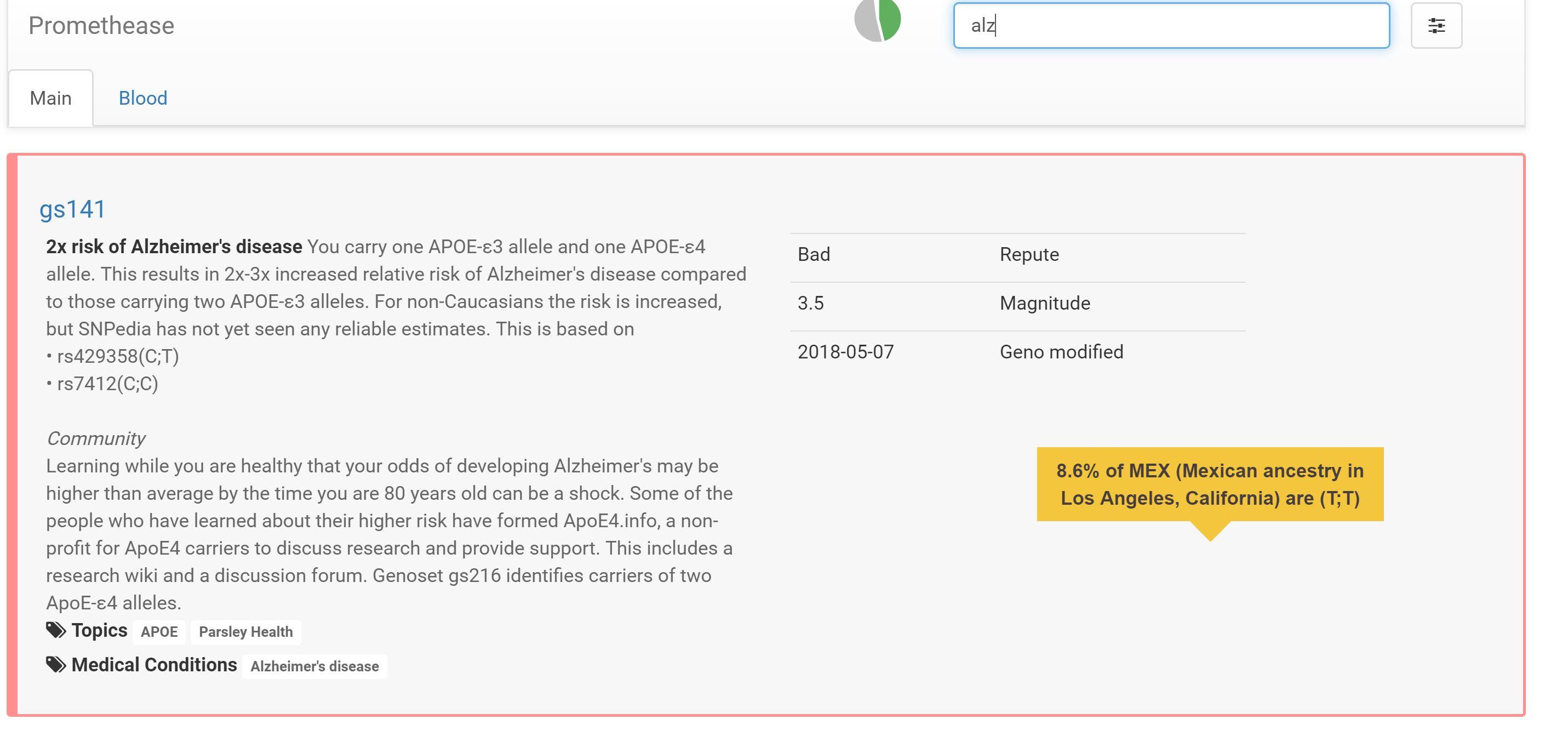
In this example, the report flags a result related to Alzheimer's disease risk and links to the research explaining the association. Promethease covers many conditions this way, including breast cancer (the BRCA genes), heart disease, and many others.
How to upload DNA to Promethease
Uploading your data to Promethease is straightforward:
- Go to promethease.com.
- Agree to the privacy terms, then scroll down.
- Either provide a URL to import your data or upload your raw DNA file directly.
Promethease accepts files from major testing companies, including 23andMe, Ancestry, FamilyTreeDNA, MyHeritage, and Living DNA, as well as standard VCF and gVCF files from exome and whole genome sequencing. It also accepts files from several other and legacy services, so check promethease.com for the current list of supported sources.
Sites like Promethease
Promethease is useful for a focused type of DNA analysis. If you are interested in alternatives, the Sequencing Partner Marketplace offers apps that analyze your DNA across a wide range of traits and conditions. Much of what those apps provide is not available from Promethease, so some people use both.
There are also other sites that accept free DNA data uploads, each offering a different way to analyze and learn from your genes.
When a Promethease report looks incomplete
When you run Promethease, or any analysis tool, on data from 23andMe, Ancestry, or MyHeritage, you may notice gaps in the report. That is because the most popular DNA tests read only a small part of the genome, which limits how much any analysis can return. For example, 23andMe and Ancestry read less than 0.1% of the genome.
This is why Sequencing offers more comprehensive testing, including clinical grade 30x whole genome sequencing, the only test that reads 100% of your genome and all of your over 30,000 genes. It gives you the complete data set to learn from now and in the future, which is what many people choose once they realize how much value their genetic data holds.
You can upload your existing DNA data or learn more about whole genome sequencing to get started.
About the author
Dr. Brandon Colby MD is a US physician specializing in the personalized prevention of disease through genomic technologies. He is an expert in genetic testing, genetic analysis, and precision medicine, the founder of Sequencing, and the author of Outsmart Your Genes.
Dr. Colby holds an MD from the Mount Sinai School of Medicine, an MBA from Stanford University's Graduate School of Business, and a degree in Genetics with Honors from the University of Michigan. He is an Affiliate Specialist of the American College of Medical Genetics and Genomics (ACMG), an Associate of the American College of Preventive Medicine (ACPM), and a member of the National Society of Genetic Counselors (NSGC).