When AI Gets Genetics Wrong: Case 2 — Variant Identity Confusion in BRCA1
By Sequencing Team, The team of bioinformaticians, Genetic Health Coaches, and writers at Sequencing.
Jul 30, 2026

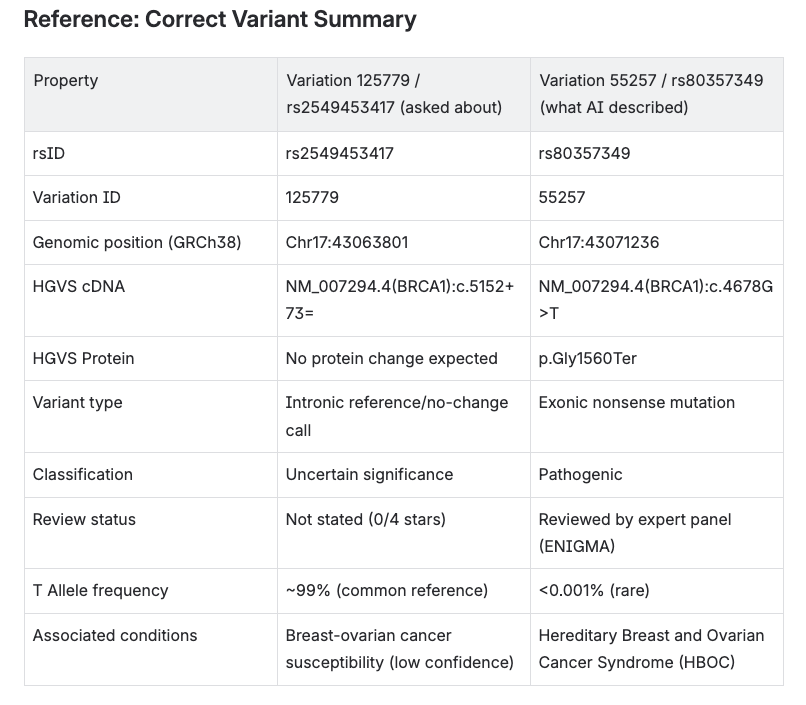
Background: The Two Variants
To understand what went wrong, it helps to know the two variants involved.
Variant 1: rs2549453417 / Variation ID 125779 (the variant the customer asked about)
- rsID: rs2549453417
- Variation ID: 125779
- Location: Chr17:43063801 (GRCh38)
- Gene: BRCA1
- Change: NM_007294.4(BRCA1):c.5152+73= — an intronic reference/no-change call
- Classification: Uncertain significance (1 submission, no assertion criteria provided)
- Review status: Not stated (0/4 stars)
- T allele frequency: ~99% of the population — this is the common reference allele
- ClinVar: RCV000112525
Variant 2: rs80357349 / Variation ID 55257 (what Google AI actually described)
- rsID: rs80357349
- Variation ID: 55257
- Associated RCVs: RCV000077583, RCV000131834, RCV000496210, RCV000508627
- Location: Chr17:43071236 (GRCh38) — a different position in BRCA1
- Gene: BRCA1
- Change: NM_007294.4(BRCA1):c.4678G>T (p.Gly1560Ter) — an exonic nonsense mutation
- Classification: Pathogenic
- Review status: Reviewed by expert panel (ENIGMA, Sep 2016)
- T allele frequency: <0.001% — rare, well-supported cancer risk variant
- ClinVar: Variation 55257
What Google AI was Asked
The customer provided their variant data — RCV000112525, chromosome 17, position 43063801, rsID rs2549453417, BRCA1, genotype TT — and asked Google AI:
"Is this BRCA variant pathogenic in any classification databases?"
What Google AI Returned
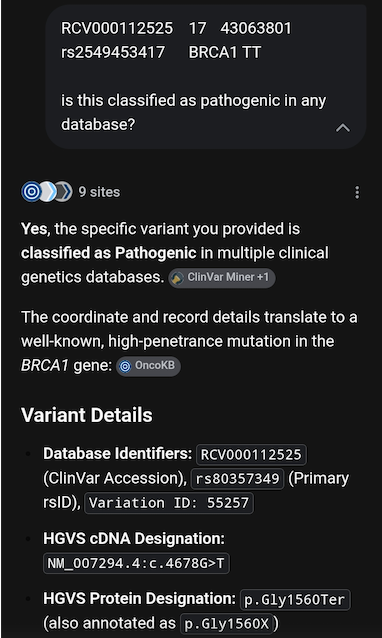
Google AI responded that the variant was Pathogenic, reviewed by an expert panel, and cited ClinVar and ClinVar Miner as supporting sources. It returned these identifiers in its response:
- ClinVar Accession: RCV000112525 ✓ (correct)
- Primary rsID: rs80357349 ✗ (wrong — this is Variant 2)
- Variation ID: 55257 ✗ (wrong — this belongs to rs80357349, not RCV000112525)
- HGVS cDNA: NM_007294.4:c.4678G>T ✗ (wrong — this is Variant 2)
- HGVS Protein: p.Gly1560Ter ✗ (wrong — this is Variant 2)
In other words, Google AI used the RCV accession number from Variant 1 but returned the molecular details and pathogenic classification from Variant 2. It appears the AI linked the two variants through a shared association of gene and the genotype without recognizing they are at different genomic positions with different clinical significance.
The Problem:
Google AI classifying RCV000112525 as Pathogenic. Returning an rsID, Variation ID, HGVS cDNA and Protein that are not related to the RCV in the question. You can actually see that one rsID was included in the question and a different one was returned.
Google AI has also indicated that the variant was reviewed by an expert panel and is the highest tier confidence in ClinVar.
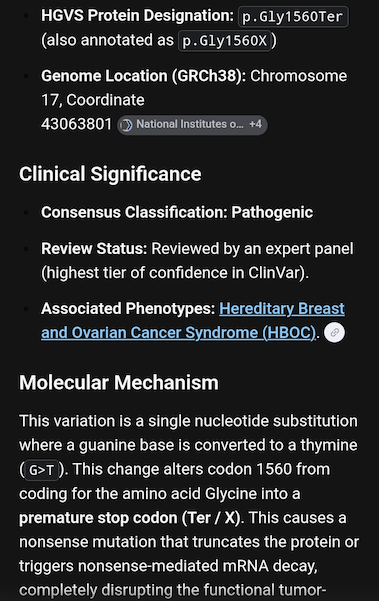
Google AI even cited ClinVar and Clinvar Miner as trusted sources of this information.
What the Databases Actually Say
RCV000112525 in ClinVar — Uncertain Significance
ClinVar classifies RCV000112525 as Uncertain significance with no assertion criteria provided and a review status of 0/4 stars. This is a low-evidence, single-submission record. There is no expert panel review for this variant.
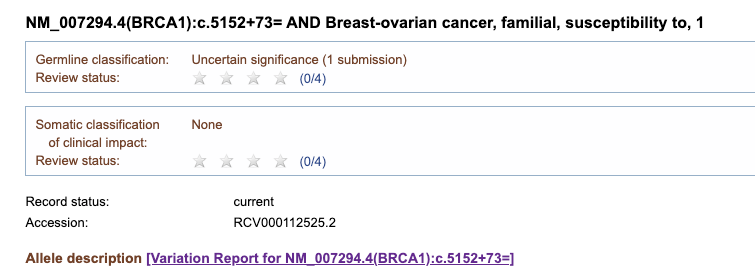
Source: https://www.ncbi.nlm.nih.gov/clinvar/RCV000112525/
Clinvar Miner also shows the same information
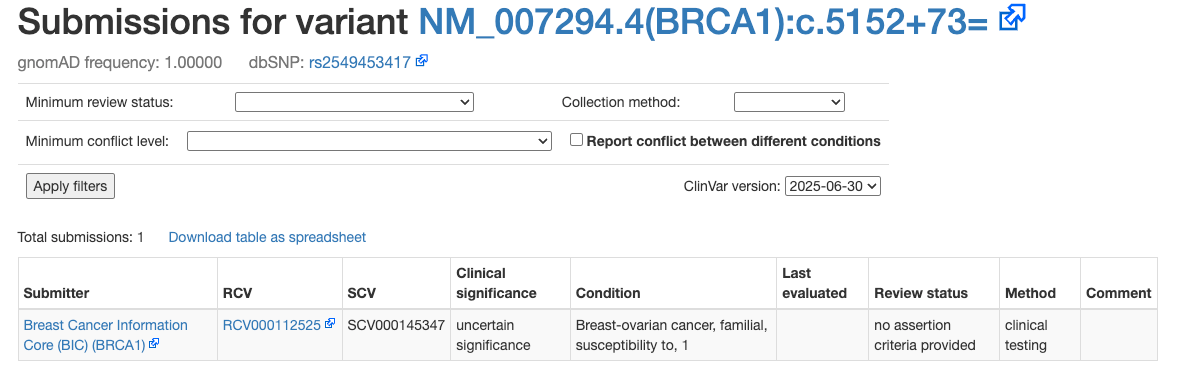
Source; https://www.clinvarminer.org/submissions-by-variant/NM_007294.4%28BRCA1%29%3Ac.5152%2B73%3D
Variation 55257 (rs80357349) in ClinVar — Pathogenic, Reviewed by Expert Panel
Variation ID 55257 is the variant Google AI actually described. It is classified as Pathogenic and was reviewed by the ENIGMA expert panel the highest tier of evidence in ClinVar. This variant is a nonsense mutation (p.Gly1560Ter) that creates a premature stop codon in BRCA1, disrupting its tumor suppressor function.
This is a well-documented, rare (<0.001%) pathogenic variant associated with Hereditary Breast and Ovarian Cancer Syndrome (HBOC).
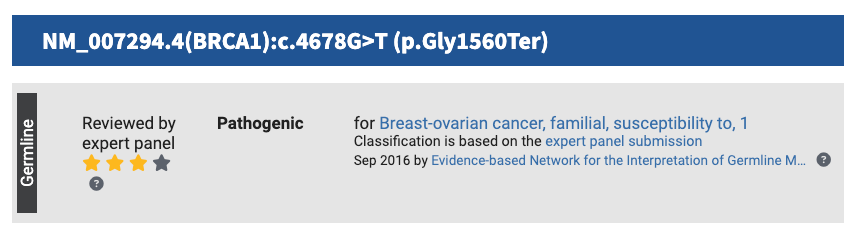
Source: https://www.ncbi.nlm.nih.gov/clinvar/variation/55257/
How the Confusion Happened
The most likely explanation is that Google AI:
- Received RCV000112525 as the query input
- Found that RCV000112525 is associated with chromosome 17 and BRCA1 and the genotype for this variant is TT. (VariantID: VCV000125779)
- Encountered rs80357349 and Variation ID VCV000055257 in the same BRCA1 gene, although it is 7000 bases away.
- Somehow crossed wires with the identifiers, applying the pathogenic classification from Variation VCV000055257 to the RCV accession from RCV000112525 (VariantID: VCV000125779)
- It also noted the customer's TT genotype for RCV000112525 (which represents the common reference allele at that position) and incorrectly interpreted it as the risk TT genotype for Variation VCV000055257.
The AI cited both ClinVar and ClinVar Miner as evidence for the pathogenic, expert-reviewed classification of RCV000112525, lending credibility to its incorrect interpretation. As noted above both ClinVar and ClinVar Miner classify RCV000112525 as uncertain significance with no supporting evidence for expert review — the opposite of what Google AI claimed.
Why the Genotype Detail Made This Worse
The customer's genotype at position 43063801 is TT, which at that position is the common reference allele present in ~99% of people. Google AI appears to have taken this TT and treated it as the risk TT at position 43071236 (where rs80357349 is located). At that second position, the T allele is rare (<0.001%) and pathogenic. The customer's actual genotype at position 43071236 is CC, the reference, meaning they do not carry the risk allele at this second position.
Using AI responsibly for Genetic Data.
At Sequencing, we are building AI that understands your DNA at the level that matters most: the exact variant, at the exact position, in the right person. Instead of guessing based on gene names or similar-looking records. Our systems anchor every interpretation to a specific genomic coordinate and transcript, and then cross-check all linked identifiers (rsID, ClinVar accession, HGVS, allele frequency) before using any external data in a result.
We also explicitly train our AI not to “fill in the blanks” when evidence is weak or conflicting. When the data are uncertain, our tools say so. This avoids incorrectly changing a variant classification to “pathogenic” just because a nearby BRCA1 change happens to be well known. Finally, AI at Sequencing operates within a safety net of validated pipelines and expert review, so that subtle mix‑ups like confusing two BRCA1 variants cannot silently turn into alarming—and incorrect—risk information for our customers.
Key Takeaways
- Variant identity matters at the nucleotide level. Two variants in the same gene can have completely different clinical significance. An AI that links them incorrectly can produce a pathogenic call for a benign variant.
- AI-cited sources may not support the AI's claim. Google AI cited ClinVar and ClinVar Miner as evidence for a pathogenic classification that neither established resource supports.
- Genotype context is essential. AI tools without access to a person's full genomic data can misinterpret reported genotypes, in this case mistaking a common reference allele for a rare risk allele.
- Confident presentation does not equal accuracy. Google AI returned a structured, sourced, well-formatted answer that was wrong in nearly every specific detail except the gene name.